
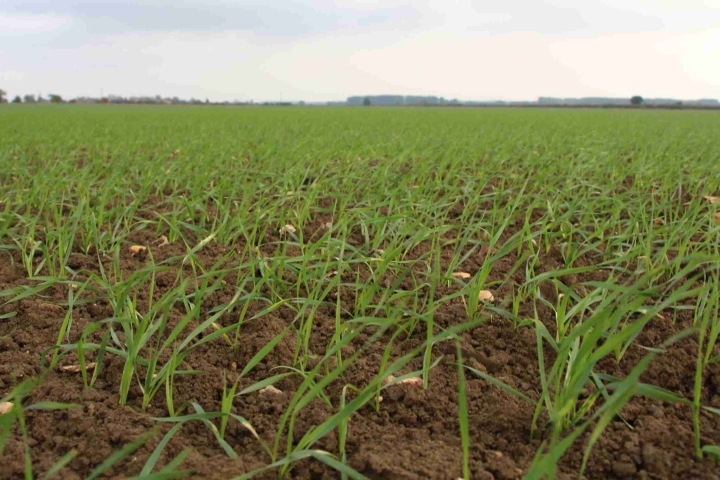
With winter wheat drilling underway across many parts of the UK, cereals growers can build the strongest foundation for crop performance by incorporating additional active ingredients with different modes of action into their herbicide programmes. According to Holly Pratt, herbicides technical specialist at ADAMA, cleaner crops start with earlier, stronger weed control decisions in the autumn.
“The best practice when it comes to tackling difficult grassweeds such as black-grass, ryegrass and brome is to delay drilling until late October, as it allows the first flushes of weeds to be removed before crops are drilled into a stale seedbed,” Holly explains. “However, with a couple of recent wet autumns still at the forefront of growers’ minds, it’s understandable that a lot of crops have already been sown.
“At the same time, pressure on cashflow following two years of drought might tempt growers to cut back on crop protection inputs. But that would only exacerbate the threat from grassweeds, as any plants that go unchecked in the autumn will have a significant impact on crop yield at harvest.
“Every successful season is built on the decisions made at establishment. It starts here. Growers should therefore give their crops the cleanest possible foundation by incorporating additional active ingredients from different modes of action into their autumn herbicide programmes. Diflufenican, pendimethalin and chlorotoluron have all been proven to improve the efficacy of aclonifen and cinmethylin-based programmes, with independent trials demonstrating their ability to deliver enhanced levels of grassweed control,” Holly advises.
Trials have shown that the addition of ANTHEM (400 g/L pendimethalin) significantly improves black-grass control when used alongside a tank mix of Proclus® (aclonifen) plus Liberator® (flufenacet and diflufenican).
“In six independent trials, which included work carried out by ADAS and NIAB, the inclusion of pendimethalin alongside these newer chemistries improved black-grass control by between 10 and 16%,” Holly continues.
“Pendimethalin can either be included at the pre- or post-emergence timing by applying ANTHEM alongside other actives, or by applying TOWER (250 g/L chlorotoluron, 40 g/L diflufenican and 300 g/L pendimethalin). Either way, black-grass control will be enhanced, helping growers take control of weed pressure before it has the opportunity to impact crop establishment and yield potential.
“Similarly, where a pre-emergence application of cinmethylin and pendimethalin has been applied, a post-emergence application of TOWER will extend the window of weed control and help maintain a cleaner crop through the early stages of development.
“The key thing to remember is that the efficacy offered by a tank mix containing several actives is often greater than the sum of its individual chemistries,” Holly concludes. “As always, timing, rate and accuracy of application are just as important as the actives being used. The strongest weed control programmes are built from the start, because once weeds emerge, you are chasing the problem rather than preventing it.
“That’s why a cleaner crop really does start here. By working closely with a qualified agronomist and making the right decisions early, growers can build the strongest possible foundation for the season ahead.”