

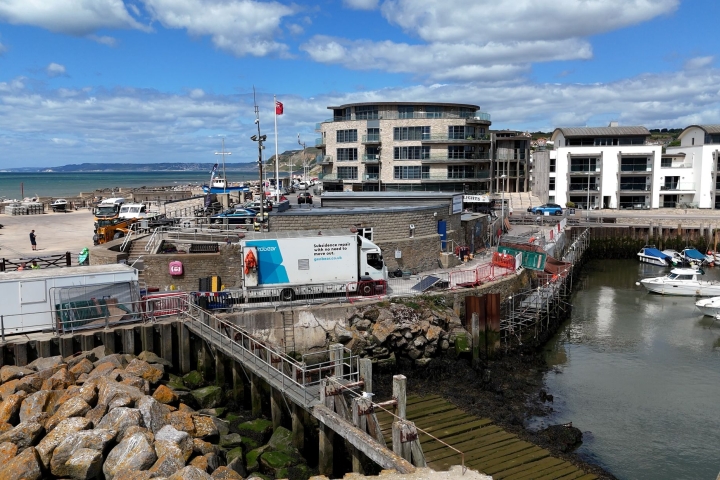
When the harbour wall in Bridport, Dorset, began to shift, the council’s engineering team knew that the 200-year-old sea defence, harbour operations, the tourism business it attracted, and the surrounding marine ecology were all in jeopardy. With the adjacent walkway cracking and unable to support heavy machinery, Dorset Council approached geotechnical contractor Geobear to buy time with rapid, non-invasive ground improvement so that the wall could be rescued.
Bridport Harbour, designed and built in the 1820s and early 1830s, is a Grade II listed coastal asset and an essential sea defence on the south coast of England. In late 2023, cracks appeared in the asphalt as the ground warped between the harbour wall and the seaside kiosks that host thousands of tourists every summer.
In March 2024, a section of the wall dropped suddenly, requiring Dorset Council to install emergency toe sheet piling, and a sensor array was added the following month to monitor for and detect further movement. The council’s engineering team engaged engineering contractor Ramboll to conduct a model of the wall’s interior. The results were concerning.
“We realised we had no choice but to act,” recalled Kevin Davis, construction manager (structures) at Dorset Council. “The waves had washed out the ground from behind the wall, causing instability and the uneven walkway surface.”
Although the toe piling prevented any further soil washout, Mr Davis and the team knew that the voids that had formed would continue to migrate upwards, as the wall wasn’t in one piece anymore. The voids would reach the surface, and the wall would either collapse inwards or outwards into the harbour.
As peak tourism season approached, the council knew the local economy would suffer if seaside kiosks had to close, and the cost to rebuild the wall would be immense. In addition to the financial cost, the team was determined to avoid the loss of this link to the area’s past.
“As it’s Grade II listed, the engineering team and its design partner, WSP, scoured the market for a solution that would help us retain the wall,” explained Tobias Carleton-Prangnell, heritage officer for Dorset Council. “There was no failure timeline we could establish, but the wall was fundamentally compromised and not in a safe condition, so we were operating on the basis that we had to stabilise it as quickly as possible.”
When a colleague shared a report on previous void filling work that Geobear had conducted for the council, Mr Davis, highways engineer Jill Crouch, and the engineering team sensed that they might have found the right solution to present to the steering committee.
Right tool for the right problem
As is often the case in taxpayer-funded projects, the council’s engineers had pressure on their decision from multiple directions. The timeline of the deteriorating wall, cost-effectiveness with public funds, minimising the impact on the nearby businesses that rely on seasonal tourism, and the environmental sensitivity of the harbour and its surroundings all had to be weighed against one another.
The harbour sits just 80 metres from a Site of Special Scientific Interest, and multiple surrounding marine areas carry Special Area of Conservation (SAC) protection. Any material used in the ground improvement required approval by the Environment Agency and the Marine Management Organisation, ruling out anything that could leach into the water.
WSP compiled a report evaluating 14 candidate solutions — excavation and cut-and-fill, sheet piling, reconstruction — and scored each against criteria including heritage impact, environmental risk, cost, working space, effect on adjacent structures, and disruption to neighbours. One represented optimal scoring while five was the worst possible score for each criterion.
Geobear’s geopolymer injection scored nine overall; the nearest piling-based alternative scored 30. Every conventional approach carried the same fundamental problem: the weakened promenade walkway could not support the weight of heavy plant machinery. Bringing in excavators or piling rigs would have risked accelerating the very collapse the team was trying to prevent.
Geobear’s process needed none of it. Technicians injected expanding geopolymer resin through small-diameter holes drilled into the promenade surface. They pumped the resin through 120-metre hoses connected to vehicles parked discreetly around the harbour perimeter — well away from the unstable ground and adjacent kiosks.
“Geobear’s solution fills voids on contact, then expands to consolidate loose material and increase the bearing capacity of the soil around and beneath the wall. Critically, it also eliminates the tidal water pressure cycling that had been driving the ongoing deterioration prior to the toe piling. “You effectively end up with an engineered foundation where there wasn’t one before,” said Mrs Crouch.
Adapting to the unexpected
Even with careful planning, the ground beneath a 200-year-old structure can still hold surprises to be navigated. During drilling, Geobear’s technicians discovered a series of historic concrete columns buried beneath the promenade, which did not appear on any modern survey.
After the drill hit the columns, the team adapted the injection grid in real time, excluding those points and carrying out proof drilling to confirm that the columns were providing structural load paths that did not require treatment. The 1 m x 1 m injection grid was adjusted around the columns, and the overall programme was unaffected.
The works ran from June 16 to July 8, 2025 — 16 working days, slightly inside the three-week programme. Pre- and post-treatment dynamic probing confirmed that bearing capacity had increased substantially across the treated area. The wall movement sensors, which had recorded erratic readings before the injection programme, stabilised. The ground was now strong enough to support the light plant machinery needed to rebuild the walkway surface to its pre-subsidence level.
Protecting the season, preserving the heritage
Managing a live construction site in the middle of a busy tourist harbour in midsummer required as much social engineering as geotechnical. The council’s on-site supervisor maintained constant dialogue with the kiosk operators, and Geobear’s team scheduled noisier activities at the far end of the wall when businesses were serving lunch. Acoustic fencing and semi-transparent hoarding preserved sight lines across the harbour for visitors.
The kiosks remained open throughout. The harbour remained operational. “We worked really hard to be a good neighbour,” said Mrs Crouch. “It was important to everyone on the project that the businesses who depend on that harbour weren’t the ones who paid the price for this.”
A platform for permanent repair
With the ground stabilised, Dorset Council now has the time and engineering freedom to deliver the permanent wall repair. The plan involves constructing an L-shaped coffer dam to create a dry working environment in front of the wall, then applying shotcrete facing reinforced with steel to restore structural integrity. Total construction time is estimated at six months. Without Geobear’s intervention, the council’s engineers estimate that timeline would have been closer to a year and would have required a return to the design process, fresh funding applications, and a far more disruptive programme.
The financial comparison is stark. A piling-based alternative would have required a piling platform alone at an estimated cost of £2 million, with further costs of at least £600,000 on top. Geobear’s contract came in under half a million, kept the wider remediation project within its existing budget, and has since been won the Ground Engineering 2026 ‘UK Project with a Geotechnical Value of up to £500K’ award.
“Geobear bought us the time we needed to do this properly,” said Mrs Crouch. “They’re one of the best companies our engineering team has worked with in a long time. When things didn’t go to plan on site, they were professional, kept us informed and just got on with solving the problem. Everyone who worked on this project said Geobear were excellent to work with.”
To understand how Geobear can help you protect infrastructure assets beset by subsidence, read about the urgent ground restoration that helped Anglian Water restore ground integrity after a sewage leak.