
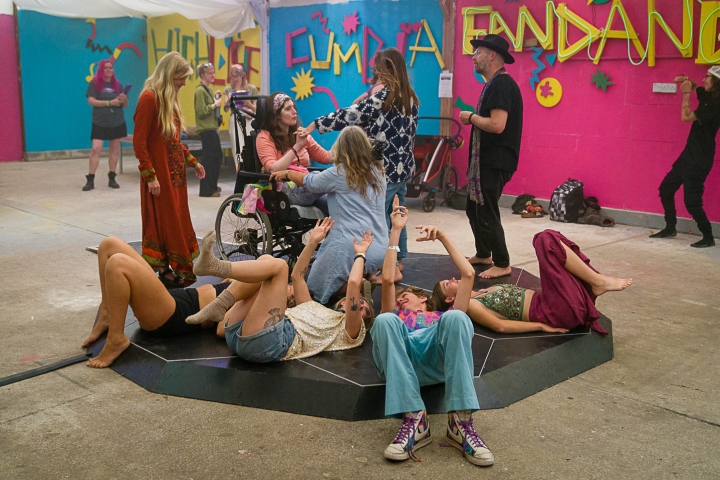
New research suggests haptic technology could open up new ways for d/Deaf, disabled and neurodivergent people to experience live music – with participants describing a vibrating dancefloor as “like being able to hear again”.
The lights go down, the crowd erupts and the first beat drops. For millions of people, these moments are part of the magic of live music. More than 24 million people attended concerts and festivals in the UK in 2025, yet for the almost 17 million people living with a disability, and the more than 18 million people in the UK who are deaf, have hearing loss or experience tinnitus, being part of the live music experience can still present challenges.
New research involving the University of Brighton and independent researcher Adrian Bossey is exploring whether haptic technology – which allows music to be physically felt – could help open up the energy, connection and joy of live music to more people, including d/Deaf and hard-of-hearing audiences.
The research will also be explored further at Hastings Storytelling Festival on Thursday 22 October, where audiences will be able to experience haptic technology first-hand. Haptic vests will be available for audiences to try during the performances, and University of Brighton researchers will be involved in the event, continuing their work exploring how haptic technology can change the way people experience live music.
Haptics are already part of everyday life. They are the vibrations felt through a phone when typing, receiving a notification or pressing a button – something many people probably switch off without thinking about it. But haptic technology can also be used to translate sound into physical vibrations, allowing people to experience music through their bodies.
Adrian started research into the potential of haptics while head of subject at Falmouth University where he explored two forms of the technology at music festivals: a haptic dancefloor, which turns music into vibrations that can be felt through the feet and body, and wearable haptic vests, which translate different elements of music into vibrations across the body. These projects led to Adrian collaborating with University of Brighton academics.
While haptic technology is already used to create immersive experiences in settings such as gaming and entertainment, haptic dancefloors remain rare in the UK and are not yet a standard feature of music festivals. The research explored whether bringing this technology into live music could offer d/Deaf, disabled and neurodivergent audiences new ways to experience, connect with and fully enjoy the unique energy of a live performance.
The results suggest they could. Participants reported that haptic technology could improve their appreciation and access to music, while also helping them feel a stronger sense of belonging and connection at live events.
For those who experienced the haptic vests, 82% said they improved their appreciation of the musical performance, while 85% said wearing one still felt like an authentic live music experience.
The technology could also help influence who feels able to attend live events in the first place. 81% said knowing haptic technology would be available would positively influence their decision to attend a live music event.
For d/Deaf and hearing-impaired respondents, 84% said haptics improved their access to music, compared with 73% of other respondents. Across all respondents, 77% said the technology improved access to the music, while 81% said it improved their sense of belonging and community.
The researchers explored two ways of making music physically felt. The first study looked at haptic vests using Woojer technology, which translate different elements of music into vibrations across the body. The second focused on Beat Blocks, a haptic dancefloor that allows people to feel the rhythm through their feet and body, and was trialled at Cheltenham Jazz Festival and Tropical Pressure Festival.
For one d/Deaf participant in the dancefloor study, the experience provided a connection to music they had struggled to find since losing their hearing.
They explained that they would normally find it difficult to pick up the beat at a festival, but when they stepped onto the dancefloor, “straight away you were feeling the beat and going in with the music.”
They described the experience as “like going back into being able to hear again.”
The researchers found that being able to physically feel elements of music could create a stronger sense of participation – allowing people to connect with the rhythm, engage with the performance and share the experience with the people around them.
The research was carried out by Dr Mandy Curtis and Dr Adam Jones from the University of Brighton and led by Adrian C. C. Bossey as part of Falmouth University’s Live Audience Accessibility & Augmentation (LAAA) projects, in collaboration with Helen Worthington, who was also at Falmouth at the time. Although Adrian has since moved on from Falmouth, he continues to lead the next stage of the research in collaboration with Mandy and Adam on, looking at how haptic technology could be used more widely and supported through policy.
Dr Adam Jones, from the University of Brighton, said: “This was really moving research for me. What really springs to mind is one participant who, after experiencing the haptic floor, enthused that it was ‘the best air guitar of my life’. For me, that really captures the joy and sense of possibility that this technology can create. I hope this research helps people to think differently about accessibility in live music – not simply in terms of removing barriers, but in terms of creating new and exciting ways for people to experience music.”
Dr Mandy Curtis, from the University of Brighton, said: “The whole experience was quite magical. We used visual research methods to capture some of these moments as audiences experienced the technology for the first time. What struck me was the sense of discovery – people weren’t simply being shown how the technology worked, they were discovering for themselves what it felt like to experience music through vibration. Those reactions were incredibly valuable in helping us understand the potential of haptics.”
Adrian C. C. Bossey, lead researcher and Chairperson at AEME (Association for Events Management Education), said: “Having spent over 40 years working in and around live music, I am very aware of the ways in which it continues to discriminate against d/Deaf, disabled and neurodivergent audiences. It has therefore been both inspiring and life affirming to work with colleagues from the University of Brighton, Deaf Rave and Beat Blocks to explore the exciting potential mitigations offered by haptics as part of an inclusive future music industry.”
The research is now continuing, with the team exploring how haptics could be incorporated into live music, including through work with musicians and performers and research into the practical and policy changes that could support its use.