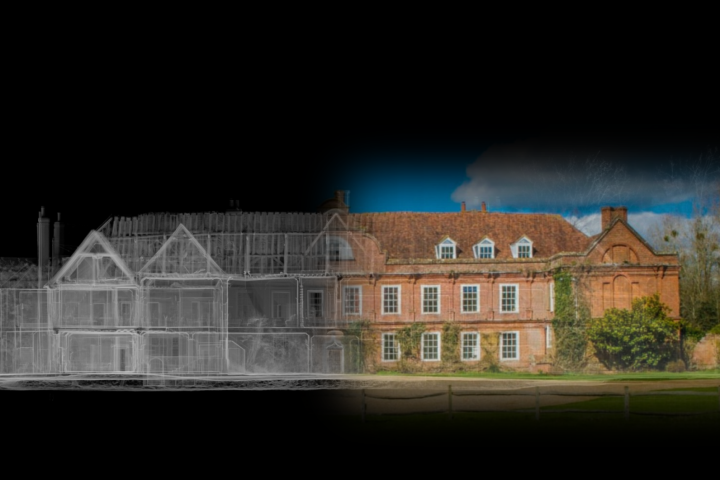
The historic Surrey Manor, West Horsley Place, is now known to millions of the public after being the setting of hit BBC Sitcom Ghosts, and due to its growing popularity, the University of Surrey have brought the Grade I listed house into the digital age through creating a detailed 3D model of it.
After completing the year-long project, that involved a full digital survey of the 15th-century manor, using high terrestrial laser scanners to capture millions of measurements, the model now lays the groundwork for a future digital twin that could transform how the estate is preserved, monitored and experienced by visitors.
It took 20 days of 3D scanning for engineers to map every room and structural feature in detail, creating a rich 3D dataset that reveals the building’s shape and even areas of hidden movement or deterioration that could not be found through visual inspection alone.
The complete survey was delivered in collaboration with Alma Soft – who converted the laser scan into a 3D model – and the Surrey team is now working with West Horsley Place to explore how the model can support conservation planning and long-term monitoring. It is found that in future phases, real-time data from sensors could be layered onto the 3D structure to track temperature, humidity, and subtle structural shifts which can all serve as an early warning-system for conservation teams.
Not only is the project monumental for conservation, but also opens the door to new public engagement opportunities, with the potential to develop virtual tours, educational materials and augmented-reality storytelling that gives visitors a fresh insight into the history and architecture of the estate.
Lecturer in Civil and Environmental Engineering at the University of Surrey, who led the project, Dr Marco Francesco Funari, said: “Looking after a historic building follows the same logic as looking after a patient. You take its history, diagnose problems, propose treatments and then monitor its condition. Our digital survey acts like a diagnostic scan for West Horsley Place – revealing hidden geometries, mapping structural movements and giving conservation teams evidence they’ve never had before.
“This is the first comprehensive digital record of the manor in its current condition, and a major step towards a full digital twin that could protect the house for future generations.”
The Director of West Horsley Place, Ilona Harris, has also commented on the project: “West Horsley Place has centuries of history embedded in its walls, and preserving that legacy is at the heart of everything we do. This collaboration with the University of Surrey gives us an invaluable new way to understand and care for the house, using digital innovation to help support the long-term protection of historic sites like ours.”
The project as a whole was supported by the University’s Institute for Sustainability and forms part of wider efforts to use digital technologies to advance sustainability and heritage conservation. Nathalie Hinds – who is Director of Operations, Innovation and Partnerships at the Institute for Sustainability – has said: “The Innovation Hub is unique because we begin with the problem to solve and work in total collaboration with our partners to design solutions that matter. This problem-led, partnership-driven approach ensures heritage places like West Horsley Place can access scientific expertise they would not otherwise reach. By bridging science and culture, we show how they can work hand-in-hand to benefit society—pushing the art of the possible and advancing knowledge for the public good.”