

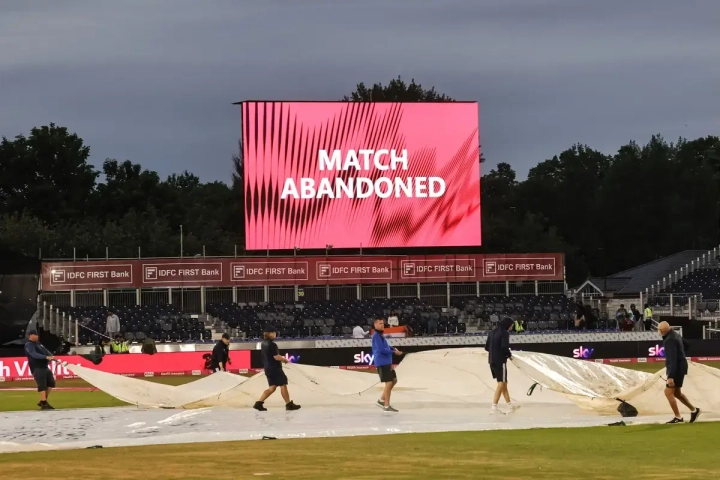
A torrential downpour ultimately dictated the narrative in Durham, denying fans what promised to be a pulsating run chase.
On Wednesday, 1 July 2026, the anticipated five-match T20I series between two of the world’s premier white-ball sides commenced at the Riverside Ground in Chester-le-Street. The first ball was sent down at 17:30 BST beneath gloomy, overcast skies that foreshadowed the evening’s frustrating conclusion. Despite a gripping first-innings display of aggressive shot-making that yielded a formidable total of 189 for 7, the match was officially abandoned without a result. Persistent and heavy rain washed away any prospect of a run chase, meaning the visitors’ bowlers and the host nation’s batters never had the opportunity to exchange blows under the floodlights.
Proceedings began with visiting captain Shreyas Iyer successfully calling the toss and electing to bat first, banking on setting a daunting total to apply immediate scoreboard pressure. This tactical choice initially appeared flawed as the home side’s new-ball attack brilliantly exploited the atmospheric conditions. The pitch offered immediate lateral movement and steep bounce, creating severe early problems for a top order eager to dominate the powerplay.
The opening exchanges were disastrous for the touring side. Sanju Samson struggled to find genuine fluency, enduring a scratchy seven-ball stay that yielded a solitary run before he was undone by the impressive pace of Saqib Mahmood. Attempting to force the pace through the off-side, Samson sliced a full delivery straight to Tom Banton at point. Matters deteriorated spectacularly moments later. A catastrophic breakdown in communication between Ishan Kishan and his opening partner led to a calamitous run-out. Caught ball-watching in the middle of the pitch, Kishan found himself stranded well short of his crease, dismissed for a two-ball duck and leaving the innings precariously positioned with just six runs on the board.
Staring down the barrel of an embarrassing capitulation, the touring side desperately required a hero to step up. They found two in the shape of a youthful, fearless Abhishek Sharma and the composed leadership of Iyer. Refusing to allow the seamers to dictate terms, the duo launched a breathtaking counter-attack that fundamentally shifted the momentum of the contest. Sharma, in particular, was in a highly destructive mood, dismantling the pace attack with ruthless efficiency.
The 25-year-old left-hander exhibited extraordinary power, racing to a scintillating half-century off a mere 20 deliveries. His innings was characterised by a total disdain for the quick bowlers, prominently highlighted when he took left-arm seamer Luke Wood for a spectacular hat-trick of boundaries. Mahmood, who had been incredibly threatening early on, was subjected to a similarly brutal assault, being dispatched for a four and two colossal sixes in a single over that leaked 21 runs. By the time the fielding restrictions were lifted at the end of the powerplay, the scoreboard had rocketed to 61 for 2, nullifying the hosts’ vital early breakthroughs.
The third-wicket alliance blossomed into a game-defining 82-run partnership, compiled at a blistering scoring rate across just over seven overs. The barrage of boundaries only ceased when Sam Curran was introduced into the attack. Utilising his trademark variations in pace and length, Curran managed to deceive the rampant Sharma, trapping him squarely on the crease. Given out leg-before-wicket for an electrifying 59 off 24 balls—an innings laced with six boundaries and four towering sixes—Sharma departed to a standing ovation, leaving his side in a significantly stronger position than when he had arrived.
Following Sharma’s departure, the responsibility of anchoring the remainder of the innings fell entirely upon the shoulders of the captain. Iyer, leading the side in a T20I fixture for the first time, rose to the occasion with a mature and tactically astute knock. Transitioning seamlessly from a supporting role to the primary aggressor, he manipulated the field expertly against the spinners and rotated the strike with ease. He reached his ninth career T20I half-century in just 38 balls, providing the necessary glue to hold the fragile middle order together. His stroke play was highly authoritative, underscored by a ferocious pull shot off leg-spinner Adil Rashid that raced to the boundary and a majestic lofted drive over extra cover against Wood for a maximum.
Just as Iyer seemed perfectly poised to accelerate towards the final few death overs, his vital knock was curtailed by a pivotal umpiring decision. Facing a full delivery from Mahmood, the skipper shuffled across his stumps in an attempt to hoick the ball over mid-wicket but completely failed to make contact. Struck flush on the front pad, he was given out instantly by the on-field umpire. Convinced of an inside edge, Iyer immediately signalled for a DRS review. However, television replays and UltraEdge graphics revealed absolutely no spike, and ball-tracking subsequently returned three unarguable reds—pitching in line, impact in line, and crashing into the middle stump. Iyer was forced to depart for a beautifully made 68 off 47 balls, an innings featuring six fours and a single six.
With the captain back in the pavilion and the score reading 165 for 6 in the latter stages of the innings, the visitors required a massive finish to push towards the psychological 190-run mark. Shivam Dube provided precisely that, executing a brutal, unbeaten cameo at the death. Striking the ball with unbridled power, Dube blasted 42 from just 21 deliveries, clearing the boundary ropes three times and ensuring the late stumble did not entirely derail the overall team total. His late flurry of runs allowed the innings to close on an imposing 189 for 7 from their full allocation of 20 overs.
From a bowling perspective, the host nation experienced a distinctly mixed evening. Mahmood was the undeniable standout performer with the white ball, showcasing genuine pace to claim 3 for 33 from his four overs, taking the crucial wickets of the visiting top and middle order. Curran offered excellent control through the middle phases, finishing with 1 for 25 from his three overs. However, the rest of the pace and spin attack struggled significantly to contain the aggressive stroke play. Wood endured a difficult outing, conceding 35 runs from his three overs without claiming a wicket, while Adil Rashid was unusually expensive, leaking 39 runs from his full quota while picking up a solitary scalp. Will Jacks (0 for 30) and Liam Dawson (0 for 26) both failed to make a breakthrough during their respective three-over spells.
First Innings: Top Batting Performances
| Batter | Dismissal | Runs | Balls | Strike Rate | Fours | Sixes |
| Shreyas Iyer | lbw b Mahmood | 68 | 47 | 144.68 | 6 | 1 |
| Abhishek Sharma | lbw b Curran | 59 | 24 | 245.83 | 6 | 4 |
| Shivam Dube | Not Out | 42 | 21 | 200.00 | 2 | 3 |
First Innings: Key Bowling Figures
| Bowler | Overs | Maidens | Runs | Wickets | Economy |
| Saqib Mahmood | 4.0 | 0 | 33 | 3 | 8.25 |
| Sam Curran | 3.0 | 0 | 25 | 1 | 8.33 |
| Adil Rashid | 4.0 | 0 | 39 | 1 | 9.75 |
Unfortunately for the capacity crowd gathered at the Riverside Ground, the thrilling batting exhibition proved to be the only live sporting action of the night. A steady, persistent drizzle began to fall during the final overs of the first innings, progressively worsening as the players left the field during the scheduled interval. The groundsmen swiftly deployed the heavy waterproof covers, diligently protecting the pitch and the bowler run-ups, but the gloomy Durham skies offered absolutely no respite. As the relentless rain intensified, large patches of standing water began to pool dangerously on the outfield, making conditions increasingly hazardous for any potential resumption of play.
With the dreadful weather showing absolutely no signs of abating, the match officials were left facing an impossible situation. Because the second innings run chase had not even commenced, a strict minimum of five overs needed to be bowled to the chasing side to constitute a legally valid match and allow for a mathematical Duckworth-Lewis-Stern (DLS) method target calculation. With less than 40 minutes remaining before the absolute regulatory cut-off time for a truncated five-over shootout, the umpires officially called the match off, entirely abandoning the fixture. Due to the frustrating lack of a definitive result, no official Player of the Match award was presented.
The abandonment leaves the highly anticipated five-match series permanently locked at a 0-0 scoreline, setting the stage for an intriguing tactical battle in the coming days. Both squads will be desperate to establish an early series advantage as they continue to build towards upcoming global ICC tournaments, looking to test new combinations and solidify their optimal white-ball setups. The touring team will take immense confidence from their explosive middle-order batting performance, having recovered brilliantly from a disastrous start. Conversely, the hosts will be eager to immediately sharpen their execution in the outfield and significantly improve their bowling accuracy during the notoriously difficult middle overs. The highly competitive series now rapidly moves on to Manchester, where the second T20I fixture is formally scheduled to take place this coming weekend, with both dedicated fanbases desperately hoping for clearer skies and a full, uninterrupted 40 overs of world-class cricketing action.