
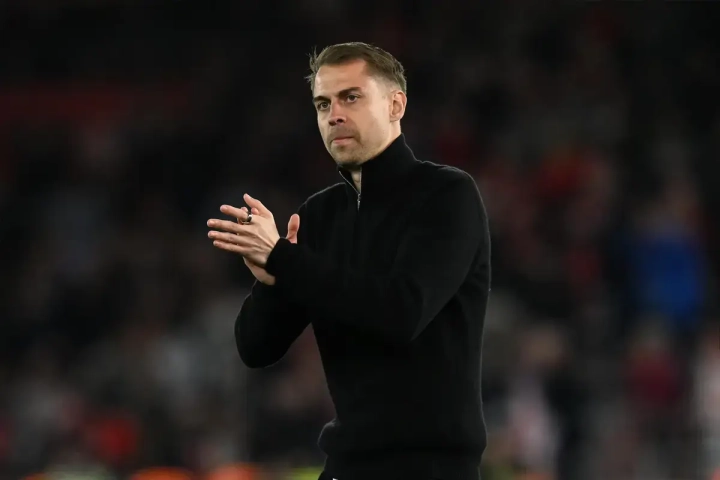
The dark cloud looming over St Mary’s Stadium has darkened further this week, as the Football Association (FA) officially levelled charges against Southampton head coach Tonda Eckert. On Wednesday, the governing body confirmed that the 33-year-old German tactician has been charged with three breaches of FA Rule E3.1, directly relating to his central role in the ‘Spygate’ espionage scandal that rocked the EFL Championship last season.
The saga, which culminated in Southampton’s unprecedented expulsion from the 2025/26 Championship play-offs and a four-point deduction for the upcoming campaign, revolves around the covert surveillance of opposition training sessions. While the club has already faced severe sporting sanctions from the English Football League, the FA’s intervention now targets Eckert’s individual conduct. The governing body alleges that the manager orchestrated a calculated campaign of subterfuge that fundamentally brought the game into disrepute.
Eckert has been given until Tuesday, 28 July 2026, to provide a formal response to the charges, leaving the South Coast club facing yet more turbulence just weeks before the new season commences.
The FA Charges Explained
The Football Association’s statement outlined the specific nature of the allegations against the Southampton manager. Eckert is accused of acting in an improper manner and bringing the game into disrepute by directing and authorising the covert observation of three separate opposition teams over a six-month period.
The charges relate to the surveillance of Oxford United in December 2025, Ipswich Town in April 2026, and Middlesbrough in May 2026. Under FA Rule E3.1, participants are strictly required to act in the best interests of the game and must refrain from any behaviour that is improper or compromises the integrity of the sport.
If found guilty by an independent regulatory commission, Eckert could face a severe touchline ban, a substantial financial penalty, or a combination of both. This would severely compound the immense pressure already resting on his shoulders as he attempts to rebuild the club’s shattered reputation and navigate a brutal 46-game league campaign.
The Anatomy of ‘Spygate’
The scandal first erupted into the public domain in May, mere days before Southampton were scheduled to face Middlesbrough in the Championship play-off semi-finals. An intern employed by the Saints was apprehended while covertly filming Middlesbrough’s training session at their Rockliffe Park base. The incident immediately triggered a sprawling investigation by the EFL, which rapidly unearthed a systemic pattern of espionage.
According to the written reasons published by an English Football League arbitration panel, the surveillance operation was directly initiated by Eckert. The first documented instance occurred prior to a Boxing Day fixture against Oxford United. The panel noted that Eckert explicitly asked his analysis team if someone could observe Oxford’s training session to ascertain their tactical shape and the fitness of a specific player, later identified as Cameron Brannagan.
The internal dynamics of the operation painted a deeply troubling picture of coercion. A young analyst was identified to undertake the task, and in written evidence submitted to the disciplinary commission, the intern stated they “didn’t really have an option” and “wasn’t provided an opportunity to say no”. After observing two Oxford sessions and transmitting photographs and videos back to the club, the intern received a WhatsApp message from a senior member of the analysis team reading: “Try and make out as much as you can please. You legend. Manager loved it.”
In April, the espionage continued ahead of a clash with Ipswich Town. When the initial intern refused a request to surveil Ipswich’s session, having been told “the boss is adamant that someone needs to go”, an academy analyst was dispatched to record the footage instead.
The panel decisively rejected Eckert’s claims that he was unaware the practice breached regulations and that the poor-quality footage yielded no sporting benefit. The Independent Disciplinary Commission condemned the German coach, stating he had authorised a “contrived and determined plan” to spy on opponents, describing the entire operation as a “deplorable approach”.
Unprecedented Sporting Sanctions
The sporting consequences for Southampton were historic and devastating. Having secured a play-off berth following an impressive campaign under Eckert, who had won the Championship Manager of the Month awards for February, March, and April, the club’s promotion dreams were summarily extinguished.
The EFL expelled Southampton from the play-offs, reinstating Middlesbrough in their place. Furthermore, the authorities imposed a four-point deduction for the start of the 2026/27 Championship season, ensuring the club will begin their next promotion push at a significant disadvantage. The panel determined that while the club may not have achieved ultimate sporting success through their actions, they undeniably sought and gained an unfair sporting advantage.
Eckert’s Public Apology and Justification
In the immediate aftermath of the scandal breaking, Eckert maintained a stony silence. He notoriously walked out of a press conference when directly asked if he was “a cheat”, drawing widespread criticism for his refusal to address the allegations.
However, following the publication of the independent commission’s damning findings, the 33-year-old released an unscripted, eight-minute video on Southampton’s official social media channels on 2 June. In the broadcast, he accepted full responsibility for the espionage operation and issued a comprehensive apology to the club’s supporters, players, and the aggrieved opposition teams.
“For everything that’s happened, I do want to apologise, and I hold my hand up because as a head coach, I am responsible,” Eckert stated. “I am responsible for everything that has happened in this football club. I am responsible for everything that has happened in my coaching staff.”
Eckert, who previously held assistant managerial roles at RB Leipzig, Bayern Munich’s youth setup, and Genoa before joining Southampton in July 2025, attempted to contextualise his actions by pointing to differing cultural norms across European football.
“In Italy or in Germany, where I was working, this is basically common practice that nobody cares about,” he explained. “When I worked in Italy for over four years, every starting line-up that we’ve chosen for the games was always out in the media before games. I just want to give you context in the way that I grew up in the football world. There are different rules in England. There are different rules from the EFL. And I should have known them.”
He concluded his address by asking for forgiveness, stating: “I am a young coach. I have made a mistake, and I take full responsibility.”
Unwavering Boardroom Support
Despite the immense reputational damage inflicted upon the club, the Southampton hierarchy has remained steadfast in their backing of their embattled head coach. Dragan Šolak, the club’s owner, publicly confirmed in early June that he had no intention of dismissing the German tactician, viewing him as a crucial asset for the club’s long-term future.
“I think he deserves a second chance and I would give it to him,” Šolak told BBC Sport. “My full support would be behind him actually, because I think he’s a super-talented manager.”
Following Wednesday’s announcement of the FA charges, the club issued a brief statement reaffirming their position. A spokesperson for Southampton FC declared: “Tonda and the club will continue to cooperate fully and openly with The FA. Our focus remains on preparations for the 2026/27 Championship season. The club remains fully supportive of Tonda and his staff as we work towards our ambition of returning to the Premier League. We are unable to comment further while the process remains ongoing, but we will provide an update to supporters as appropriate.”
The Road Ahead
As the 28 July deadline for Eckert’s formal response looms, Southampton find themselves navigating incredibly turbulent waters. The club must prepare for a gruelling 46-game Championship marathon burdened by a four-point deficit, while their manager faces the highly realistic prospect of an FA-mandated touchline ban that could rule him out of the critical opening weeks of the season.
The ‘Spygate’ scandal has irreversibly altered the narrative surrounding Eckert. Once heralded as a tactical prodigy and the exciting architect of a thrilling Southampton revival, he must now undertake a monumental rebuilding project—not just of his squad, but of his own professional integrity. How the squad responds to this relentless off-field adversity, and how the broader footballing public receives Eckert when the new season commences in August, remains the most compelling subplot of the upcoming Championship campaign.