
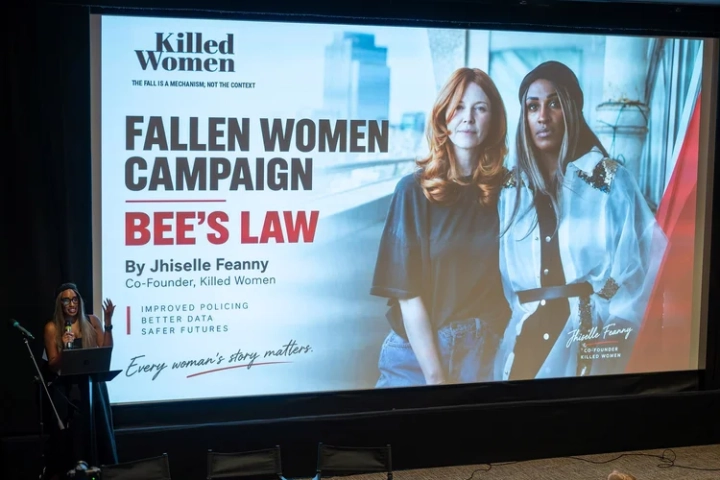
Centre for Women’s Justice (CWJ) is proud to support a campaign launched by Killed Women this week for a new, standardised approach to police investigations into fall-related deaths, in honour of Bianca (“Bee”) Thomas.
Killed Women co-founder Jhiselle Feanny lost her sister, Bee, in 2018, after she fell from an 11th-floor balcony. She was 25 years old. An inquest concluded that her fall was accidental, but Bee’s family still have unanswered questions about the circumstances of her death.
Killed Women’s campaign launch coincides with the release of ‘Fallen Women’, a BBC3 documentary broadcast on Tuesday, which investigates how the police respond to unexplained ‘fall deaths’ where domestic abuse may be a factor. The documentary, presented by Stacey Dooley, raises important questions about the number of young women – including Bee – whose deaths have been deemed accidental after a fall from a height, even where a partner or ex-partner has initially been arrested at the scene.
A report researched and prepared by Killed Women – also published this week – which draws on official police data, found that 31 out of 39 (known) fall deaths over a five-year period were women, three of whom were pregnant when they fell.
86% of suspects identified in relation to fall deaths were already known to the police for domestic abuse, and almost half had a reported history of coercive/controlling behaviour, and/or were known as ‘high-risk’ domestic abuse perpetrators.
In a number of the cases a suspect was arrested, but no further action was taken.
The “Bee’s Law” campaign calls for all police forces to adopt a standard methodology in every case involving a fatal fall – known as the ‘B.E.E.’ method’ – to include thorough, forensic examinations of a victim’s body and injuries, following standard homicide procedures following arrival at a crime scene, and fully investigating the possibility of domestic abuse, by gathering evidence from professionals, family and friends.
CWJ shares Killed Women’s concerns that some cases where women have fallen – with a male partner or ex-partner present – have been inadequately investigated by the police or Crown Prosecution Service (CPS). In 2019 we acted for the family of Jourdain John-Baptiste, who fell to her death from a fourth-floor balcony after witnesses heard an argument between her and her then boyfriend, but whose case was refused charge by the CPS.
Kate Ellis, Joint Head of Litigation at CWJ, who has represented a number of bereaved families campaigning for investigations following fall-related deaths, said:
“‘Bee’s Law’ sets out a simple, easy-to-remember checklist of actions for investigators to follow, which should be minimum standards following any domestic or fall-related death.
“These are basic steps that police forces should already be taking in these cases, but which – from our experience – are often overlooked. That is why we need mandatory guidance, adopted by all police forces, which ensures every officer follows the ‘B.E.E. method’ in every case – so that if there is sufficient evidence which points to a homicide, the perpetrator can be held accountable.
“In light of Killed Women’s research, I am hopeful that the Home Office, the National Police Chiefs’ Council, and the College of Policing will work together to ensure ‘Bee’s Law’ is introduced as a national standard.”
CWJ is also acting for Bee Thomas’ family as they seek answers in respect of the criminal investigation and the circumstances of Bee’s death.