
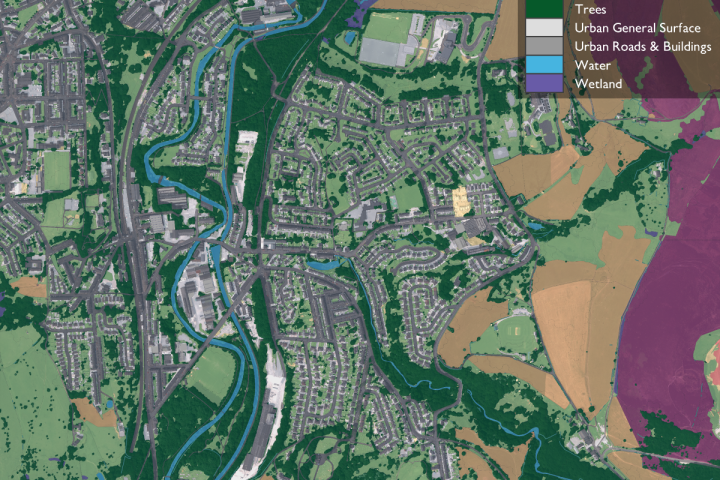
The tool could help speed up the Government’s ambition to build 1.5 million homes sustainably
Ordnance Survey (OS) has come up with a ready-to-use tool for rural and urban developers in England to support their target of providing a ten per cent Biodiversity Net Gain (BNG).
Defra’s BNG legislation means that as part of planning applications, land and property developers are required to assess baseline habitats using Defra’s biodiversity metric, submit a biodiversity gain plan, deliver ten per cent gains on- or offsite through credits, and maintain and monitor habitats for 30 years. Last week, Defra confirmed that BNG will become mandatory for Nationally Significant Infrastructure Projects from this November.
OS Enhanced Land Cover (ELC) Beta provides an efficient tool to support the new BNG challenges, potentially speeding up the Government’s ambition to build 1.5 million homes during this Parliament. It is a foundational dataset combining topography and land cover from the OS National Geographic Database, OS aerial imagery and OS terrain 5 with a range of third- party open habitat data. This includes information from Natural England’s Living England, the Rural Payments Agency’s Crop Map of England and UKHab’s classification system. UKHab is the UK standard classification for referring to habitats and underpins the statutory biodiversity metric which developers must use.
Most significantly, the product can be used to conduct BNG assessments – both for early workflow desktop analysis and for use by ecologists in the field. Developers, landowners, and ecologists can also better understand the composition of their land cover at scale before conducting more detailed surveys. For example, Wessex Water has used OS ELC data to understand the biodiversity of hundreds of sites in one spatial picture and apply this data to their 30-year projections for BNG.
Linckia, one of a recent Geovation Accelerator cohort, is the partner that takes OS ELC data and serves it to Wessex Water via their Habitat Fabric dataset and BNG application. Co-founder Luke Chittock said:
“We really like OS Enhanced Land Cover, which we integrate into Linckia’s BNG solution on the ESRI platform. It gives us a scalable, authoritative, and auditable approach that we can trust, delivering better outcomes for our customers. Applying our ecology expertise to the data to create Habitat Fabric, we have seen a 40% reduction in data processing costs from earlier approaches, rising to 90% reduction when compared to processing imagery for the same outcomes.”
ESRI has highlighted the journey of OS ELC data flowing into Habitat Fabric via ESRI tools and into the hands of ecologists in its latest blog, showing how digital information can make a real impact on the ground. With the far-reaching Government housing target, the increased efficiencies offered by OS ELC data could be crucial.
Dr Jack Parkin, product manager for the built and natural environment at OS, said:
“The Government’s home-building target, combined with Defra’s BNG legislation, has made a market condition where ecologists are in high demand. One of the benefits of OS Enhanced Land Cover is to boost the productivity of those ecologists and to make their time count. We aggregate multiple geospatial datasets together to provide a provisional assessment of habitats on the ground which saves ecologists time both in desktop analysis and pre-screening in the field. This can shave days, or even weeks, from development times, and with 1.5 million homes in the pipeline, that could really add up.”
Built as a foundational geospatial dataset for ecology management, OS ELC could also help support the planning of nature-based restoration projects, such as re-wilding, flood risk management and green corridors.
OS ELC is available exclusively via Ordnance Survey’s extensive partner network. For more information, visit OS Enhanced Land Cover (Beta) | Data Products | OS.