
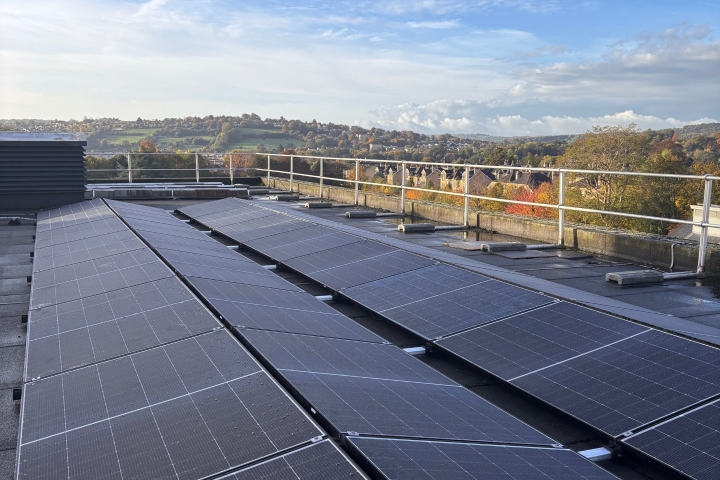
The Royal United Hospitals (RUH) Bath NHS Foundation Trust has marked a major milestone in its journey to becoming a cleaner, greener hospital, by switching on 650 new solar panels as part of its ambitious Project Clean Heat.
The panels are the latest development in a major programme of works that aims to modernise the hospital’s ageing heating infrastructure, cut carbon emissions, and create a more sustainable environment for patients, staff, visitors and the wider local community.
The investment comes at a time when the impacts of climate change are becoming increasingly visible. As well as affecting the environment, changing weather patterns and extreme temperatures – as well as the other effects of climate change such as air quality – can have a significant impact on people’s health, particularly for older people, young children and those with existing health conditions.
The NHS has committed to becoming the world’s first Net Zero health service by 2045, with an ambition to reach net zero for the emissions it has control over by 2040. Sustainability has therefore been a core focus at the RUH for many years, with Project Clean Heat being one of the largest environmental improvement programmes ever undertaken on the hospital site.
The new solar panels alone will save 42 tonnes of carbon every year, equivalent to the annual emissions of around seven typical UK households.
Jon Lund, Site Finance Director and executive sponsor for the project, said: “At the RUH, one of our goals is to make Bath one of the healthiest places to live and work in the country. This means looking beyond the healthcare we provide and considering the wider factors that influence people’s wellbeing.
“Project Clean Heat will improve our facilities today, while also creating a greener hospital for future generations. Alongside reducing our environmental impact, the new heating systems, improved insulation and upgraded lighting will help to create a more comfortable environment for patients, visitors and staff.”
The solar panels are just one element of the wider decarbonisation programme. Other recent milestones for the project include the installation of air-source and water-source heat pumps on the hospital rooftops, which are due to become operational later this year.
Additional improvements include installing high-quality LED lighting, better insulation and more advanced heating controls, all of which will reduce energy use while improving the physical environment in the hospital.
Once complete later in 2026, the whole project will reduce the RUH’s annual emissions by 3,212 tonnes of carbon every single year – the equivalent of 14,500 return journeys between Bath and Edinburgh in the average petrol car, or the same as powering more than 1,000 homes in the UK for a year.
The impact of the work was recently recognised at the prestigious national IHEEM Healthcare Estates award, where it was shortlisted in the Net Zero Innovation category. This recognises teams, initiatives and projects that deliver real-world carbon reduction in healthcare estates, particularly those that could also provide a model for other NHS organisations.
The work has been funded by a multimillion-pound grant from the Department of Energy Security and Net Zero, administered by Salix. The RUH is delivering the project in partnership with Veolia and the Carbon Energy Fund.