
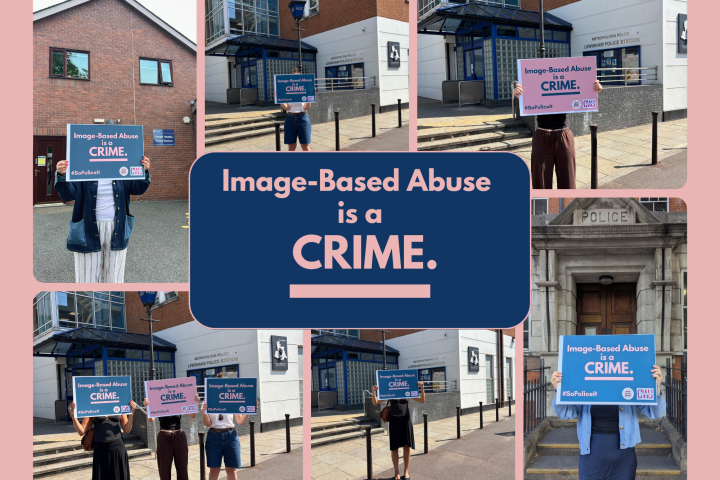
Today, #NotYourPorn, Centre for Women’s Justice and Leigh Day submitted a police super-complaint into systemic failings in the investigation of image-based abuse.
Our super-complaint draws together testimony from over 100 survivors(1), police data from forces across England and Wales, input from frontline organisations working with survivors of image-based abuse, and academic research, to demonstrate that the current policing response to image-based abuse is failing survivors.
Image-based abuse is the taking, sharing, or creating of intimate content without the survivor’s consent, or threatening to do so. With rapid AI innovation helping abusers find new ways to create and disseminate material, image-based abuse is a serious and growing threat, especially for women and girls, who make up 98.9% of reported images(2). Image-based abuse has become a “national emergency”(3) – referrals to the Revenge Porn Helpline increased by over 4,000% from 2015 to 2025(4).
Despite this explosion of criminal behaviour, our research reveals a consistent pattern of policing failures at every stage of the survivor journey. Survivors reported that image-based abuse was frequently dismissed, misunderstood or not recognised as criminal offending at all. Investigations were delayed or abandoned, evidence was not gathered, communication was poor. Opportunities to protect survivors and prevent ongoing harm were missed. We found that:
- Across the 39 police forces we considered, the charging rate for image-based abuse offences was just 4.5% in 2025(5). In some police forces it was lower than 1%. Several police forces reported only a single charge under s.66B in the entire year(6).
- In some forces, we found that rates have actually decreased since the introduction of new image-based abuse offences in the Online Safety Act 2023(7).
- Home Office data showed that there were only 569 total charges(8) in 2025/2026 for image-based abuse (for context, the Revenge Porn Helpline received almost 25,000 reports in 2025(9))
- Of those who responded to our short-form survey, 44% of survivors chose not to report what had happened to them to the police. Of those who did report, 65% described issues with evidence gathering in their case and only 15% reported that the police took steps to remove / takedown their images. Of those who did report, when asked if they would report IBA to the police again, 48% of participants said they would not.
- Of our 23 detailed case studies, almost 80% reported issues with evidence gathering including a failure to identify or interview suspects, failure to seize/examine devices, or a poor understanding of online platforms and digital evidence. Many told us they were asked to gather evidence of their own non-consensual content, forced to ask friends or family members to download and screenshot humiliating images due to police inaction. Over 60% reported excessive delays and the same reported issues with poor communication.
- None of the survivors from our detailed case studies received appropriate signposting.
Survivors told us:
Tamara* said: “It felt like to them, it wasn’t a priority, it wasn’t even a crime.”
Juliet* said: “Police involvement has not alleviated the harm caused by this offence; instead, it has intensified my distress and left me feeling powerless and completely unsupported as a victim.”
Reilly* said: “I had not needed the police my whole life when I did, I did not get any help.”
Our super-complaint reveals a policing response that is fragmented, inconsistent and incapable of meeting the scale of the threat posed by image-based abuse.
We are calling on police to:
- Create a consistent national guidance for the policing of image-based abuse
- Make reporting image-based abuse easier
- Act more swiftly to investigate cases, including identifying perpetrators and preserving evidence
- Protect survivors by applying protective orders and bail conditions wherever needed, and referring survivors to appropriate support services
- Conduct more effective investigations, improving their understanding of developing technologies and ability to handle digital evidence
- Communicate better with survivors during their investigations
- Play their part to increase charging rates for image-based abuse
Elena Michael, #NotYourPorn, Director and co-founder:
“The current police approach to investigating image-based abuse is clearly failing when survivors are left extremely traumatised from the process and unsupported. In many cases, image-based abuse isn’t treated like a crime at all. This is unacceptable. Image-based abuse is a crime so it needs to be not only policed, but policed justly.”
Harriet Bland, Centre for Women’s Justice, Solicitor and Policy Adviser:
“Image-based abuse is a growing problem – and ever-changing with the rapid development of new online platforms and AI tools available to abusers. Without an urgent overhaul of police guidance and training on image-based abuse – which must be regularly updated – and a clear national strategy rolled out across forces, survivors will continue to be let down.”
Claire Powell, Leigh Day, Associate Solicitor:
“Survivors have told us how police responses have left them feeling powerless, humiliated, and as if they are somehow to blame for the crimes committed against them. This cannot continue. Our evidence shows that in the absence of proper enforcement, the new laws which campaigners have worked tirelessly to have introduced, do not protect survivors, and perpetrators remain able to act with impunity. Drastic improvements are necessary and our recommendations are targeted at establishing a national standard for policing image-based abuse to ensure all survivors receive proper access to justice.”