

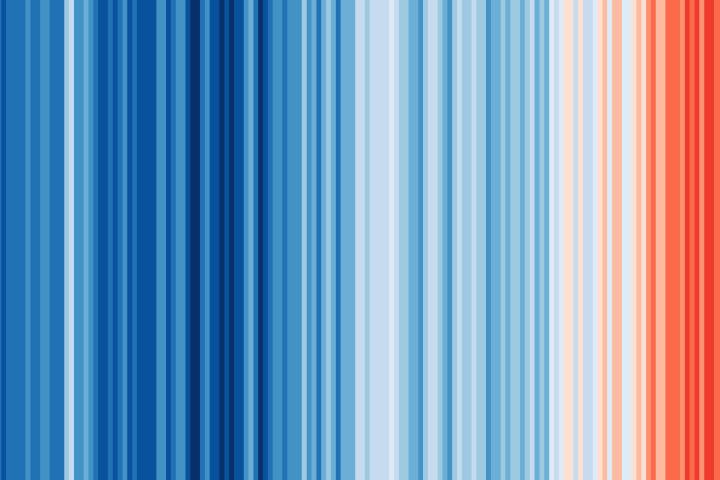
Earth’s third-warmest year on record has been marked with another dark red stripe in the climate stripes graphic, underlining the continued and unprecedented pace of global heating.
The iconic visualisation, which shows changes in global temperatures over the past 176 years, has been updated following the release of new annual data published on Wednesday 14 January. The figures draw on temperature records from the Copernicus Climate Change Service, ECMWF, NASA, NOAA, the UK Met Office, Berkeley Earth and the World Meteorological Organisation (WMO).
The latest data confirms that 2025 was the third-warmest year ever recorded globally, adding a new dark red stripe to the climate stripes graphic to represent the extreme temperatures experienced during the year.
Professor Ed Hawkins, the University of Reading climate scientist who created the climate stripes, said the slight cooling compared with the two previous years should not be misinterpreted.
“2025 was slightly cooler than 2023 and 2024, but this drop should not be seen as a sign that things are getting better,” he said. “The last 11 years have been the warmest 11 years on record, and 2026 is almost certain to continue this sequence due to the relentless accumulation of greenhouse gases in our atmosphere, primarily from burning fossil fuels.”
Professor Hawkins warned that rising temperatures are already having tangible impacts on people and communities.
“Warmer temperatures have real impacts,” he said. “Hotter heatwaves cause more health issues, heavier downpours increase flooding risks, and rising sea levels create greater coastal flooding hazards. We must urgently step up our efforts to cut emissions and prepare for the warming that is now inevitable.”
The climate stripes graphic illustrates changes in average annual global temperatures since 1850, with red stripes indicating hotter years and blue stripes representing cooler years relative to the 1961–2010 average.
Alongside the global update, new climate stripes have also been produced showing the UK’s warmest year on record, based on Met Office data dating back to 1884. Separate stripes for Reading show 2025 as the town’s second-warmest year on record, using data from the University of Reading Atmospheric Observatory going back to 1908.
The latest update reinforces the growing body of evidence that climate change is accelerating, with recent years consistently breaking temperature records across the world.