

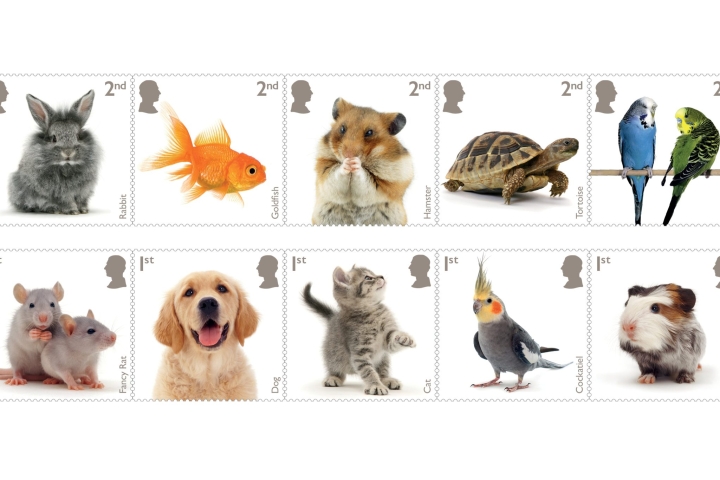
Royal Mail is celebrating the nation’s love of pets with a new set of 10 Special Stamps featuring some of the UK’s best-loved domestic animals.
The stamp set features a, rabbit, goldfish, hamster, tortoise, budgerigar, fancy rat, cockatiel, dog, cat and guinea pig, capturing the character and charm that make pets such cherished members of households across the country.
The UK is a nation of animal lovers, with an estimated 60 percent of households owning a domestic pet. Dogs remain the most popular pet, followed closely by cats, while many households also share their homes with birds, rabbits, guinea pigs, tortoises, turtles and fish.
Pet-keeping has a long history, stretching back thousands of years. Evidence suggests that dogs were the first to be domesticated, and today they top the list as the most popular pet, followed closely by cats.
While dogs and cats continue to lead the way, the stamps also recognise the joy brought by smaller furry friends such as guinea pigs, hamsters and fancy rats, as well as the intelligence and personality of parrots, including the cockatiel and budgerigar. The issue also celebrates the decorative and therapeutic presence of goldfish and the slower, long-lived appeal of tortoises.
David Gold, Director of External Affairs and Policy at Royal Mail, said: “Pets hold a special place in many British people’s homes and hearts. This new stamp issue celebrates the animals that bring comfort, joy and companionship to millions of people across the UK, from loyal dogs and independent cats to bright birds, curious small animals, colourful fish and characterful tortoises.”
Royal Mail worked with animal expert Tamsin Pickeral on the stamp issue. Tamsin is also author of The Invention of the Dog, The Majesty of the Horse, The Dog: 5,000 Years Of The Dog in Art and The Beauty Of The Cat: An Illustrated History.
Tamsin commented: “Pets in all their shapes and sizes are so important to us, primarily for the huge amount of comfort and joy they bring, but also culturally. The history of pet keeping and the transition of essentially wild animals to sharing our homes over the millennia is a fascinating one, and it is a privilege to bring some of these wonderful animals to life through this series of stamps.”
The stamps, and a range of collectible products, are available to pre-order from today (13 August) at www.royalmail.com/pets and by telephone on 03457 641 641. A Presentation Pack including all 10 stamps is priced at £14.45. The stamps go on general sale from 20 August.
Stamp-by-stamp:
Rabbit – Lionhead Rabbit
Domestic rabbits make fun pets and are known for their genial nature. They are clever and can be taught tricks, in addition to responding to basic commands. There are many different types of domestic rabbit, ranging from the huge Flemish and continental giant breeds, weighing as much as 11kg or even more, to the tiny dwarf rabbit that can fit in the palm of a hand. The handsome lionhead rabbit is fairly small, weighing around 1.5kg. Rabbits’ front teeth can grow up to 3mm per week, which means that it is essential for them to be fed roughage, such as hay, to keep their constantly growing teeth worn down. Due to their social nature, rabbits live more happily in groups.
Goldfish
Goldfish are one of the most distinctive domestic freshwater fish and come in many varieties. Contrary to common belief, a University of Oxford study has shown that they have good memories, and goldfish enthusiasts can attest to their different personalities. Goldfish are members of the carp family and were originally bred in ancient China as a food source. At that time, they were largely grey, but natural mutation resulted in some displaying red and orange scales. These were selectively bred to develop the brilliant range of colours seen today, which include white, yellow and black. Goldfish are delightful first childhood pets and, given good tank-water hygiene and careful feeding, can live to around ten years old.
Hamster – Golden Hamster
There are over 20 different breeds of hamster, but the golden, or Syrian, is one of the most familiar. It is a large breed, weighing 100g or more, but – like all hamsters – has a lifespan of only around two years. Hamsters are nocturnal, preferring to sleep through the day and becoming very active at night, when they like to explore. They use their fine whiskers, which they vibrate at high speed, to help them sense objects. They also like to dig and in the wild they live in deep burrows underground. The word ‘hamster’ comes from a German word that means ‘to hoard’, and the golden hamster can hoard up to half its body weight in its large cheek pouches.
Tortoise – Hermann’s Tortoise
Tortoises and turtles are part of the same reptile family, but tortoises are entirely land-dwelling, while turtles spend most of their time in water. Both creatures have been in existence for more than 230 million years, alongside dinosaurs, until the mass extinction event that wiped those large animals from the planet around 66 million years ago. Tortoises are adaptable and able to survive in a range of habitats in the wild. Domestic tortoises, of which Hermann’s is one of the most popular, are sociable, charismatic and inquisitive. They like to roam, and so require a large, enclosed external area, as well as a freely accessible interior space. Tortoises are very long-lived, with an average lifespan of 50 to 100 years.
Budgerigar
Affectionately known as budgies, these small, brilliantly coloured birds are the world’s most favoured pet bird. They originate from the outback of Australia where, in the wild, they are predominantly light green and can live in huge, social flocks, with the consideration of ‘safety in numbers’ being key. They were discovered by European settlers in the 1800s and gradually introduced to Europe, America and the rest of the world. Budgies are one of the smallest members of the parrot family, at approximately 18–24cm in length. They are extremely chatty and full of personality. They are also great mimics and can learn an extensive array of words, phrases and tricks, making them entertaining pets.
Fancy Rat
Domestic rats are known as fancy rats and come in a variety of colours. They are intelligent and, due to their excellent senses, can be trained to perform various tricks and tasks; in fact, rats are used by the military to detect landmines. Historically, rats in Europe were unfairly associated with the spread of plagues, although in fact it was fleas on the rats that were the perpetrators. Conversely, in some religions, rats are deemed sacred and are even worshipped. The Japanese kept domestic rats as early as the mid-1600s, and by the 1800s rats were being bred in Europe for rat-baiting and later for laboratory experiments. Today, fancy rats are seen as rewarding pets, with squeaky-clean personal hygiene.
Dog – Golden Retriever
Dogs are the UK’s most popular pet, with an estimated 30 percent of adults owning at least one of the UK’s 13 million dogs. Although there are conflicting accounts of when humans first domesticated dogs, it is generally accepted that our relationship with them dates back anywhere between 30,000 and 14,000 years ago. There are hundreds of different dog breeds, and the golden retriever, with its distinctive golden yellow coat, is one of the most beloved. These dogs are known for their extremely affectionate and nurturing nature, especially with children, and are often chosen as family pets. They are clever, trainable and usually keen to please. The golden retriever is a working, high-energy gundog breed, with significant exercise requirements.
Cat – Tabby
The second most popular pet in the UK, the domestic cat has over 70 different breeds. They come in all shapes and sizes, from the large, medium-long-haired Maine coon to the tiny singapura, which can weigh as little as 1.8kg. Cats exhibit a wide range of coat colours and lengths, and there are also hairless breeds, such as the sphynx. All cats carry the gene for tabby coat colouring, although the distinctive stripes, swirls and spots are not always visible. Tabby cats nearly always have an M-shaped mark on their forehead. Cats in general are gentle, intelligent and tend towards independence. They can be trained if they choose to be – but are also very skilled in training their owners.
Cockatiel
Cockatiels are the smallest members of the cockatoo family and are native to the semi-arid areas of Australia, where they live in large flocks. With their stunning looks and sweet, affectionate personalities, they are very popular as pets. Cockatiels are highly intelligent, engaging birds who like to interact with their owners and are excellent mimics. They are capable of learning a varied vocabulary, and their mimicry skills can extend to household gadgets such as kettles or doorbells. Their jaunty crests give a visual indication of their mood, with a raised crest showing excitement, a flattened one indicating that they are relaxed and a lowered one denoting caution.
Guinea Pig – Crested Cavy
Guinea pigs are members of the rodent family and trace their origins to the Andes, where they are believed to have been domesticated several thousand years ago. Originally, they were kept and bred for food but gradually began to appear in South American art and folklore. In Peru they were used in religious ceremonies and to diagnose illness. European traders brought guinea pigs to Europe in the 16th century, and it is said that Queen Elizabeth I kept them as pets. Today, there are numerous breeds, which exhibit a range of coat colours and configurations. Piggies make wonderful pets, as they are friendly, chatty and very active, sleeping only a few hours each day.