
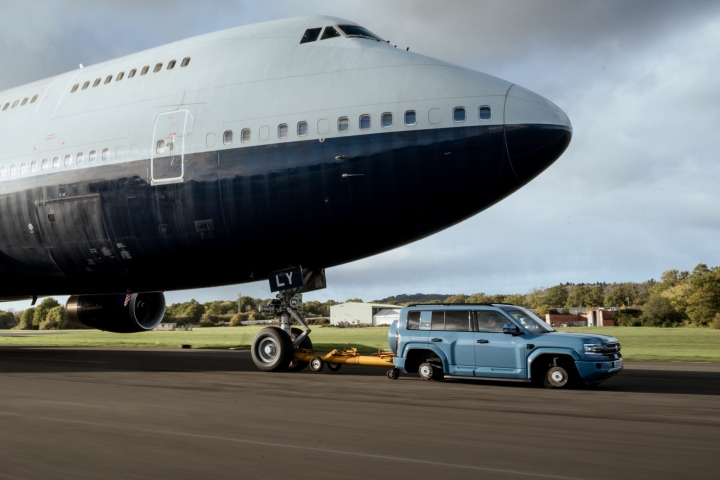
DENZA, the premium technology-oriented automotive brand of the BYD Group, has successfully towed a Boeing 747 with its new BAO 5 SUV in the UK, using just two driven wheels. This incredible achievement represents several firsts for the brand’s rugged off-roader, including the first production car to tow a plane on two wheels and the first to tow a 747 on electric power alone.
While moving a 180-tonne aircraft on all four wheels would have been an impressive achievement in its own right, DENZA’s engineers wanted to push the boundaries even further. Ambition and innovation are cornerstones of the BYD Group, with its 120,000 engineers and over 40 patents per day. They set out to achieve something hugely ambitious: something that had never been tried before, and something that truly challenged the capability of the advanced DMO plug-in hybrid powertrain.
Taking place at Dunsfold Aerodrome in Surrey, three runs were completed: on all four wheels, a second on three wheels, and a final run on two wheels. Over the combined distance of all three runs, allowing for stops for filming and to remove wheels, the BAO 5 towed the 747 for a total of 1,600 metres – the equivalent of four laps of a standard size athletics track. The driver behind the wheel for these successful attempts was BYD UK’s senior technician Mark Gallifant, who comfortably surpassed his own previous-best payload of a double-decker bus fully loaded with fare-paying passengers.
The car used for these runs was a standard, production-specification BAO 5 in Ultimate guise with minimal modifications. A bespoke towing attachment was fabricated to connect the BAO 5 to the aircraft, while interior passenger seating was removed to facilitate the installation of 4500kg of ballast when driving with two wheels, and 2,000kg when driving on three wheels. In addition, small stabilisers were added to each axle to balance out the removal of the two driven wheels.
The BAO 5’s DMO plug-in hybrid powertrain was also used in its normal form. This features three electric motors (one driving each axle, plus a third generator unit) and a 1.5-litre turbocharged petrol engine, delivering a total system output of 544PS and 760Nm of torque. The BAO 5 has a range of 56 miles on electric power alone, and a range of 537 miles on a full tank of petrol and a full charge.
The aircraft used for these runs was a Boeing 747-400, which left active service in 2020, but which still retains its engines and fully furnished interior, weighing approximately 180 tonnes.
In typical British fashion, the weather conspired to make things even more challenging for the project’s technical team. While initial practice runs were carried out with ease, torrential rain on the day of the final attempts made things far more challenging. However, eventually, the runway dried out sufficiently for the car to find enough traction to get the 747 moving. After each run, vehicle checks were completed and these confirmed no signs of stress on the powertrain, chassis or even the tyres.
Videos of the DENZA BAO 5 towing the jumbo jet can be viewed here: https://youtu.be/JfuZRUr7P24
| DENZA BAO 5 specification | |
| Trim | Ultimate |
| Dimensions (L/W/H, mm) | 4921/1970/1930 |
| Wheelbase (mm) | 2800 |
| Kerb weight | 3035 |
| Max system power/torque (PS/Nm) | 544/760 |
| Front electric motor max power/torque (PS/Nm) | 272/360 |
| Rear electric motor max power/torque (PS/Nm) | 388/400 |
| Rear electric motor max torque (Nm) | 400 |
| Petrol engine displacement/aspiration | 1.5L, turbo |
| Max petrol engine power/torque (PS/Nm) | 150/240 |
| 0-62mph acceleration time (seconds) | 5.0 |
| Top speed (mph) | 112 |
| Battery capacity (kWh) | 31.8 |
| WLTP electric range (miles) | 56 |
| WLTP combined range (miles) | 537 |
| CO2 emissions | 30g/km |
| Max charging power (DC) | 100kW |
| Battery type | BYD 2nd Generation Blade Battery (LFP) with Cell-to-Chassis (CTC) technology |
| Towing capacity (kg) | 2500 |
| Front/rear suspension | Double wishbone with DiSus-P intelligent body-control system |
| Front/rear brakes | Front fixed calipers with ventilated discs |
*WLTP data